The BIM (An Bord Iascaigh Mhara) 50-footer fishing boats, introduced to Ireland in the early 1950s, bridged the gap between smaller traditional vessels and the larger trawlers that followed, with eighty-eight vessels built between 1949 and 1970. One County Wicklow family from the fishing port of Arklow maintained a 50-year connection to the MFV Ros Aoibhinn, believed to be one of the very last of these boats. Now, a new owner is working to preserve this final BIM 50-footer, that was powered by an ultra-rare Rolls Royce engine.
IMPACT ON COASTAL IRELAND
There’s no doubt that the 50-footer fishing boats that were better equipped, more powerful, and more comfortable played a key role in transforming the Irish fishing industry by meeting the inshore fishing needs of their time. As Pat Nolan observes in Sea Change – The Rise of the BIM 50-Footer and Its Impact on Coastal Ireland, these vessels represented a pivotal shift for coastal communities, both economically and culturally.
INVESTMENT IN FISHING
From 1922 to 1949, Ireland’s fishing industry suffered from a lack of investment. In response and possibly under pressure from fishermen, the Irish Sea Fisheries Association (ISFA) offered loans for small boats and later introduced a hire-purchase scheme for larger vessels. This initiative, later supported by An Bord Iascaigh Mhara (BIM) after its 1952 founding, played a key role in the development of what became known as the BIM 50-footers.
SCOTTISH DESIGN
Inspired by the robust lines of traditional Scottish fishing vessels, the design for the 50-footers was developed by naval architect James Cahill Stafford, who was commissioned by the Irish Sea Fisheries Association in the 1940s. While individual boats showed minor variations, all followed his core plans rooted in this proven Scottish model and the distinctive form of the BIM 50-footers remains instantly recognisable to this day.
IRELAND MADE
The new 50-footers were built in small numbers at boatyards along the Irish coast, including Arklow, Baltimore, Dingle, Dun Laoghaire, Killybegs and Meevagh, providing valuable local jobs and a welcome boost to the fishing economy.
The first 50-footer, Uncle Pat, was launched in May 1949, with Saint Mel following in October of the same year, both built in Killybegs. An example of build costs from 1954 comes from the BIM boatyard in Baltimore, County Cork, where the first 50-footer built at the yard, Ros Droichead, was launched at a cost of £7,025.
A total of eighty-eight 50-footers were built between 1949 and 1970. While the majority featured black-painted hulls, a few stood out with a distinctive varnished timber finish. The final vessel in the series, the eighty-eighth boat, St. Colette, was launched from Dingle, County Kerry in March 1970 at a cost of £22,800.
ROS BOATS
Many people know these boats as Ros boats, based on the common belief that all BIM 50-footers were named with the prefix “Ros.” While this wasn’t true for every vessel, the name has become a familiar shorthand for the entire class.
The first of the fifty-one boats to include “Ros” in its name was Ros Beg. Authorities had decided to use ancient Irish place names beginning with “Ros”, such as Ros Cairbre, for these vessels. New owners were given a shortlist of such names to choose from. However, from the mid-1950s onward, many BIM 50-footers dropped the “Ros” prefix, as owners preferred to name their boats after loved ones or choose their own names. A further deviation occurred in the early 1960s when five boats adopted the prefix “Rath” instead, such as Rath Connla.
HOW MANY LEFT?
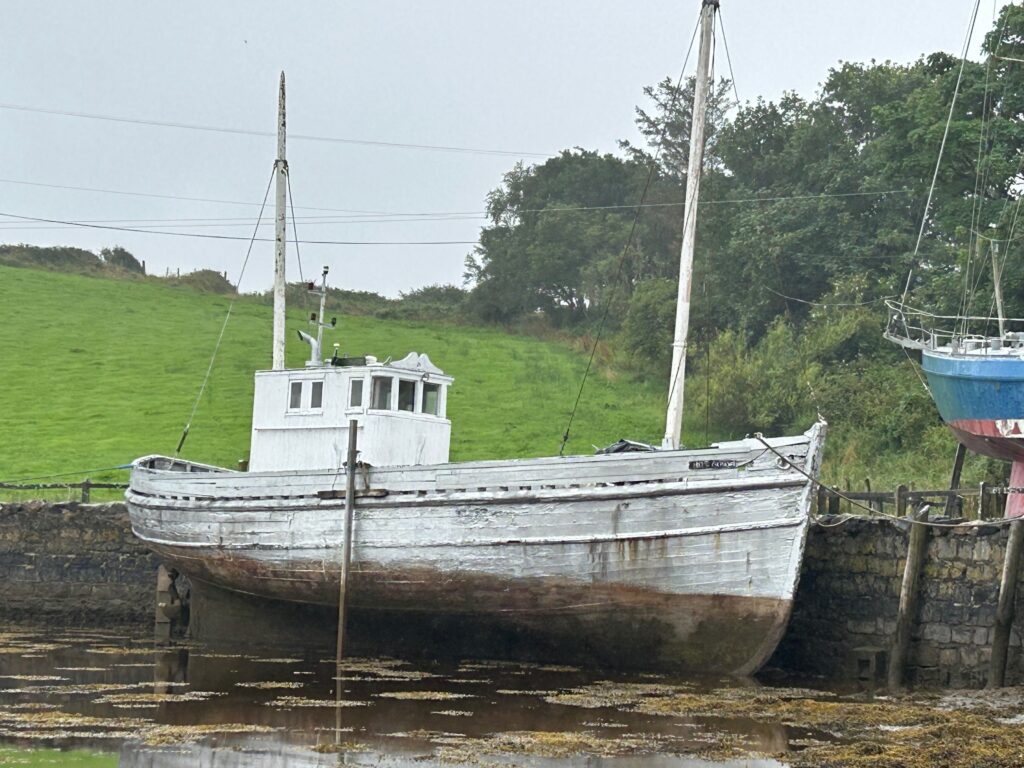
Writing in 2008 in his book on the 50-footers, Pat Nolan noted that at that time six BIM 50-footers were still active in fishing, a few others were involved in other maritime work, and around seventeen had been converted for use as pleasure craft. From our research in writing this article in July 2025 we believe that there are only a handful of BIM 50-footers in existence today. Among them is the Ros Beithe, the last wooden working fishing vessel built at the BIM yard in Dingle in 1964, now renamed Whaleheart. Ros Aoibhinn, owned by James Cahill, is currently in the water at Westport, County Mayo, while a third 50-footer is in dry dock in Galway.
ROS AOIBHINN 50-FOOTER
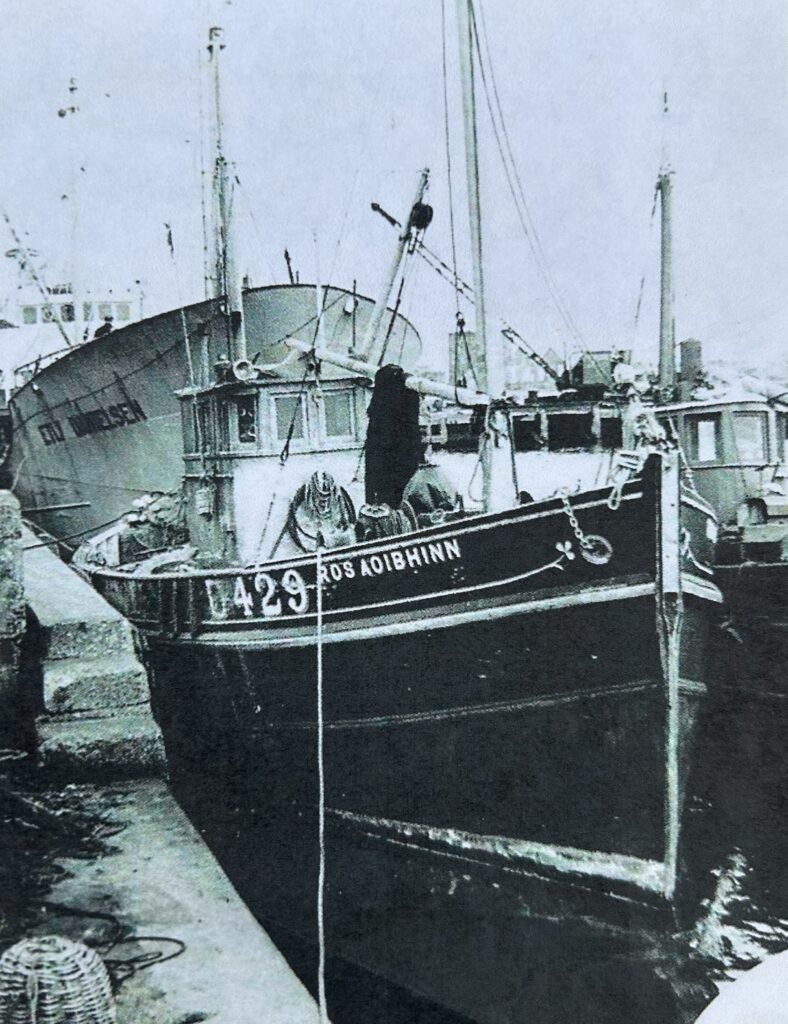
The MFV Ros Aoibhinn was in the same fishing family at Arklow County Wicklow for over fifty years. In the late 1950s, Johnny Hickey, nicknamed “Shag Hickey” for his habit of saying “shag” instead of cursing was working in the United States and sending money home to his brother Pat in Arklow, County Wicklow, to help purchase a 50-footer.
The vessel they bought was the MFV Ros Aoibhinn (Irish for “beautiful bay”), built at Meevagh Boatyard in County Donegal between 1953 and 1955. Although the exact year of construction is uncertain, Pat Nolan’s research on the 50-footers suggests that ownership details are also somewhat unclear. However, after returning from America, Johnny took over as her skipper.
FISHING LIFE
From the fishing port of Arklow, Johnny and Pat Hickey fished grounds from Rockabill, off the coast of Skerries north of Dublin, down along the east coast to Rosslare Harbour. In those days, as had been the norm from the late 1940s, all navigation was done by eye. Fishermen relied on handed-down knowledge and a mental chart of hundreds of coastal landmarks, using these in combination with a compass. But they never went to sea in mist or fog, without clear visibility, even the most seasoned crews wouldn’t take that risk.
From the 1960s to ‘70s, Ros Aoibhinn was a whitefish boat and during the winter months, they fished for herring out of Dunmore East and Kinsale. During the winter herring season in the 1960s, Dunmore East didn’t always offer reliable shelter. In rough weather, especially when the wind came from certain directions, keeping boats safely in the harbour was a challenge. In such conditions, it was common for Ros Aoibhinn and the fleet to head inland up the River Suir to find calmer, more protected waters closer to Waterford city.
There were also incidents with the fleet as when Jack Buchanan’s boat went out of the harbour for day fishing and capsized. Of the six crew on board, five were lost and Johnny Hickey, who was later commended for his seamanship, brought Ros Aoibhinn in and picked up the sole survivor.
CONRAD LEE
As his uncle’s Johnny and Pat Hickey grew older, 11-year-old Conrad Lee began joining them at sea. By then, the boat was operating as a day fishing vessel out of Dún Laoghaire Harbour, working Monday to Friday each week, a typical pattern for the fishing industry at the time.
Conrad recalls learning the fishing trade from his uncles, who made it clear that the work was tough and governed by strict rules. Before a fisherman was ever paid, he had to “splice, mend, and take a watch”, only then would he earn his share. And there was no cursing on board; if you did, you didn’t get paid. Conrad told us a few of the traditional sayings handed down through generations of fishermen, highlighting how superstition often went hand in hand with hard-earned practical knowledge, such as: “Never go to sea on a holy day unless there was holy water on the net.”
On Conrad’s first day fishing with his uncle’s outside the harbour, they motored south into Courtown Bay, spending several hours shooting and hauling in their nets. As they were preparing to head home, they spotted two 16-year-old girls who had drifted out to sea in a rubber dinghy from Courtown Beach. They quickly brought the girls on board, and then navigated close enough to shore for the girls to wade safely onto to the beach and back to their relieved families.
Conrad Lee fished for many years with his uncles aboard Ros Aoibhinn out of Dunmore East until he was about 16 years of age until like many a teenager he lost interest
RONAN LEE
Ronan Lee fished until the 1990’s and fondly remembers working with his uncle’s Johnny and Pat who taught him the fishing trade. Along with serving his time on the Ros Aoibhinn he worked on several other Arklow-based boats.
He remembers the early starts and the boat pulling away from the harbour at 5:00 a.m. with the coal-fired stove already burning. Food on board was basic but filling, thick slices of streaky bacon and, in the absence of a fridge, plenty of tins of condensed milk. He still recalls, with a mix of awe and amusement, how his uncle Pat could balance a kettle of boiling water on the palm of his hand!
Following a family tradition of fishing stretching over three hundred years, Ronan Lee is the last member of his family still working at sea. Working in Dunmore East as a self-taught netmaker, since it’s not a formally recognised trade, he has mastered the craft on his own. As far as he knows, he is the only left-handed netmaker in all of Ireland, setting him apart in both tradition and technique.
ROLLS ROYCE
In the late 1960s, Rolls-Royce made a determined effort to enter the Irish 50-foot fleet, offering 200 hp C-Class marinized petrol engines at favourable prices to boat skippers. These replaced the original 88 hp Kelvin engines, which were widely considered underpowered.
However, the nineteen skippers who installed the new engines in 1969 soon found them unsuitable for fishing, largely due to high running costs. The main issue was the engine’s lubrication system, it consumed about one-fifth of a pint of oil per cylinder per hour, operating almost like a two-stroke. During the 1970s oil crisis, this meant using around five gallons of lubricating oil per voyage, making it financially unsustainable.
However, Johnny and Pat Hickey were content to live with the high running costs of the C-Class engine. While every other skipper eventually replaced their Rolls-Royce with a 95 hp or 130 hp Gardner engine, the Hickeys continued to run theirs for the next 30 years.
ROS AOIBHINN PRESERVED
Johnny ‘Shag’ Hickey, grand-uncle to Conrad and Ronan, died thirty-five years ago. At the time, it was assumed that his boat, Ros Aoibhinn, would go to his nephew 24-year-old Ronan. Instead, the boat was left to Conrad’s grandmother, who later passed it down to her son Pat.
In 2000 Pat Hickey sold the fishing licence onwards and the vessel to its current owner, James Cahill of Westport, County Mayo. However, before James could take Ros Aoibhinn to sea and bring her to Mayo, Bill Brickley, owner of the dock and boatyard formerly known as Tyrrell’s of Arklow, hauled the vessel out of the water and carried out a range of essential maintenance work before she was ready to set sail.
Since 2000 Ros Aoibhinn is moored year-round near Westport, County Mayo. To accommodate her, James built an 80-foot pier using timber he felled from his own land. He undertook an extensive refurbishment of the vessel, which included the replacement of 150 frame bolts and several frame futtocks, the curved timbers that form the ribs of the hull. Multiple hull and deck planks were renewed and all deck ironwork was replaced with galvanized steel components. The electrical wiring throughout the boat was also fully replaced.
The original gearbox, an old American “Chicago” model from the 1940s, proved troublesome and had to be replaced with a modern unit. We were told it was a real struggle to get it working, its age made repairs nearly impossible, and restoring it would have cost more than it was worth.
Additional work included a complete refurbishment of the accommodation areas, the installation of modern communications and safety equipment, and the fitting of new timber booms and gaffs. The deck was thoroughly caulked and re-caulked as part of the restoration.
Interviewed for Pat Nolan’s book James Cahill stated that “theRos Aoibhinn is seaworthy, comfortable, safe, and above all dry both above and below and at sea.” Preservation work is ongoing, and in 2024 the deck was covered with torch-on felt.
ROLLS ROYCE REPLACEMENT
Around five years ago James installed what is now the third engine in the Ros Aoibhinn, following the original 88 hp Kelvin and subsequent 6-cylinder, 200 hp Rolls Royce. The current engine is a marinized Gardner, originally from a Dublin bus. According to James, it runs so smoothly that a cup of tea placed on it while running remains undisturbed. As a test for his newly fitted engine James loaded the hold of Ros Aoibhinn with several tons of turf, secured nine curraghs he had built to the hatch, and set sail for a folk boat festival in Brest, Brittany, France where he went on to sell all the curraghs.
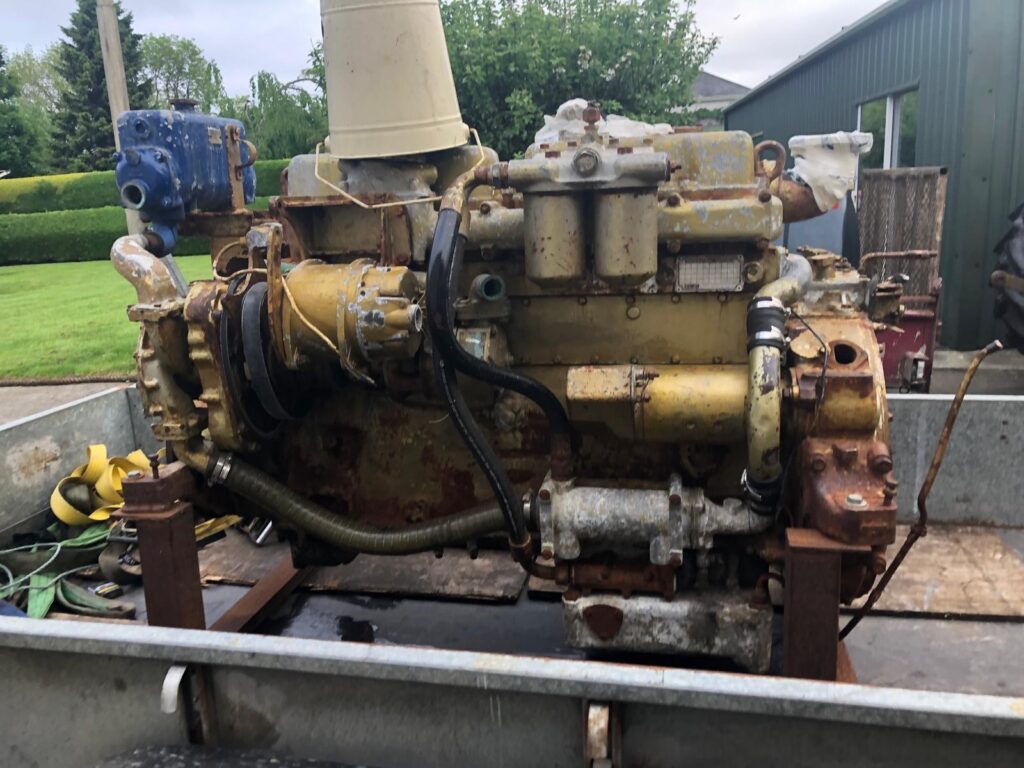
Conrad Lee heard on the grapevine that the Ros Aoibhinn was now moored near Westport, he made his enquires and was soon chatting with James Cahill on the telephone about his own family connections to the 50-footer. Soon after, Conrad made the trip to Mayo to view the boat firsthand and was shown the ultra-rare Rolls-Royce engine. When James had removed it, he reconditioned the cylinder head and had carefully stored the restored engine in his shed in Westport.
Eager to see the unused engine go to a good home a deal was struck and Conrad had bought himself an engine. Now how to get it home? With the assistance of a very helpful friend with a Transit van, Conrad used a chain block to lift the one-and-a-half-ton Rolls Royce engine and carefully slid it into the back of the van. Once back in Arklow, a friend with a digger helped unload it and placed it onto skids made from RSJs to make it easier to move around.
THE FUTURE FOR ROS AOIBHINN
When we asked James why did he buy the Ros Aoibhinn and not a newer boat, his response was adamant; “If I don’t preserve her, nobody will.”
As this is possibly one of the very last of a fleet of eight-eight historic Irish fishing boats James is keen for a museum to take on the Ros Aoibhinn. If your museum is interested, please do let us know.
If you like what we are doing, please SUBSCRIBE on www.irelandmade.ie — your support helps us keep the stories of Irish transport history alive and accessible to all. Thank you for being part of the journey.
Check out our previous video-story on the “1st motorised fishing boat in the British Isles designed & built in Ireland 1908” https://fb.watch/rMWjZwzO1G/
If you have an idea for a story, please email Kevin Reid [email protected]
Sources of Information and Photo Credits:
AP – Associated Press
National Museum of Ireland
Off Scotland Webpage – the 50 foot boats of the 1950’s and 1960’s
Sea Change – the rise of the BIM 50-footer and its impact on coastal Ireland – Pat Nolan
Whaleheart – aka: Ros Beithe Facebook page