Fay Taylour was a pioneering woman of international motorsport and the winner of the first ever Leinster Trophy motor race held at Skerries in 1934. Over her long and remarkable life Fay Taylour competed in speed events on four continents, dealing with incredible obstacles at every step. However, it was the darker side of her personality and fascist and antisemitic belief system, that saw her imprisoned for over three years during World War II, that would forever cloud her legacy.
Please SUBSCRIBE – your support allows us to travel, research and preserve stories of Irish transport, past and present.
EARLY LIFE
Helen Frances “Fay” Taylour was born on April 5th 1904 in Birr, Co. Offaly into an Anglo-Irish ascendency family (‘a Protestant on a horse’ – Brendan Behan) the middle of three sisters. Her father Herbert was an officer (County Inspector) in the Royal Irish Constabulary (RIC) with very strong English ties who left the RIC to live in England following Irish Independence. Taylour was left to continue her education in Ireland, attending Alexandra College on Earlsfort Terrace as a border. Her upbringing was described as idyllic. She was a keen sportswoman, excelling on horseback, tennis, hockey and other outdoor pursuits. Her father purchased a car, a Buick, that Taylour would drive around the family property as a teenager imbuing in her an early love of anything automotive and mechanical.
INFLUENTIAL WOMEN
Her family was large with many uncles and aunts on both sides of her family tree. Her mother Helen, who was born in Dresden, Germany, was delicate and often in poor health and died in 1925. Her father remarried to a much younger woman in England who did not care much for Fay or her sisters. However, there were several strong female influences and role models in Taylour’s young life not least of which were her aunts who were amongst the first women in Ireland to attend university (the now defunct Royal University), one of whom was a suffragette who would be imprisoned in Holloway jail (where Taylour would spend part of her internment during WWII) and another who qualified as a doctor and became Ireland’s first female anaesthesiologist.
ENTERING MOTORSPORT
Taylour grew up amongst the tumultuous background of the 1916 Easter Rebellion and War of Independence that followed that shaped a latent republican leaning that emerged late in life. After leaving Alexandra College in 1921, Taylour moved to England to be closer to her father. She purchased her first Levis motorcycle (that was soon upgraded) with the proceeds of an award she received at school and immediately began looking for ways she might begin competing in trials and other speed events. Quickly, Taylour realized that women were forbidden to compete straight up with men and were confined to women’s only events and the occasional speed trial, scramble or head-to-head match-up. However, she persisted and soon established herself as a serious competitor with several notable performances.
RISE OF THE “SPEEDWAY QUEEN”
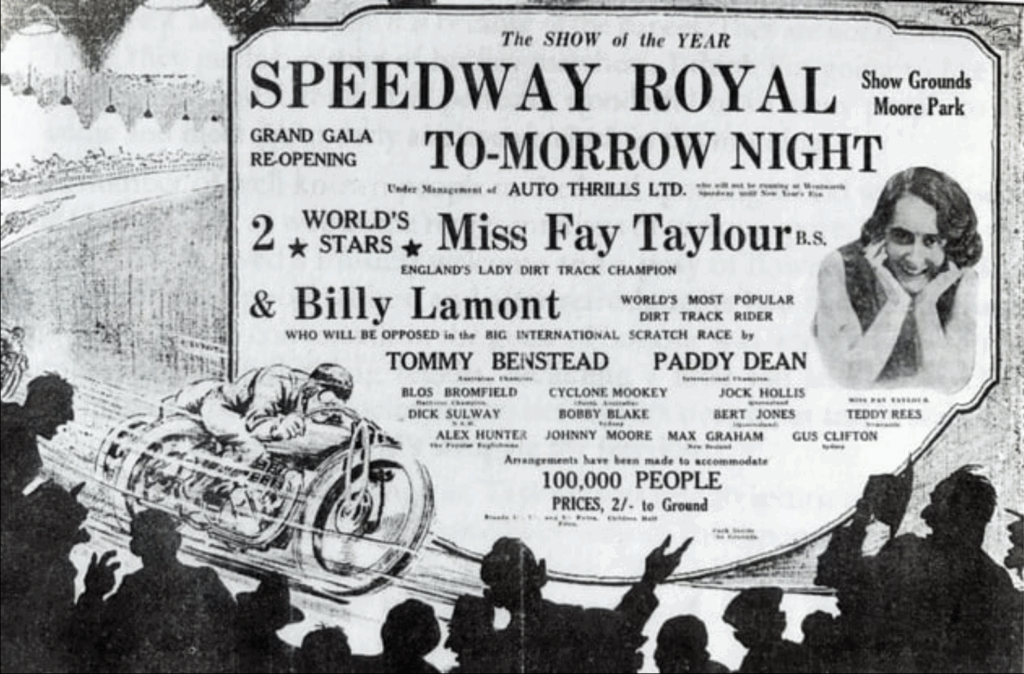
In the 1920s in England the second most popular spectator sport after Association Football was Speedway Motorcycle Racing. Using greyhound tracks and football grounds including Wembley Stadium (where Fay Taylour would set a lap record), that had cinder tracks installed around the pitch, there were several leagues across England and tens of thousands of spectators turned out weekly to cheer on their heroes. Cullen describes in great detail how Taylour got her start as a speedway rider that in under two years would have her crowned as the “Speedway Queen”. She was a natural at speedway riding, learning how to “broadside” or use opposite lock to drift around the loose surface of the track. Racing mostly in demonstrations as she was not permitted to race directly against men, she became a big attraction, drawing in big crowds wherever she appeared.
In late 1928 she travelled to Australia where she barnstormed across the country appearing in Perth, Sydney, Brisbane, Melbourne and Adelaide. She took on the greatest Australian speedway riders of the day and more often than not would beat them in head-to-head match ups. Her fame grew exponentially and thanks to Taylour who had a natural gift for self-promotion, she began doing press and radio appearances across the country.
THE 1930 BAN ON WOMEN
In May of 1930 the Auto Cycle Union who governed speedway racing in the UK introduced a blanket ban on women competing in all forms of 2-wheeled motorsport. No real justification was provided but the impact was devastating on Taylour’s burgeoning career. She sought out alternative venues to race in Europe but increasingly it was becoming impossible for Taylour to fund her racing as all her English backers had pulled out. This was to become a repeating theme of her life right to the end as she always seemed to be in hard financial straits.
TRANSITION TO FOUR WHEELS
She made a trip to India and competed in the Calcutta-Ranchi 300-mile speed run breaking the existing record by 40 minutes in a 1931 Chevrolet. This was her first time competing on four wheels and instantly Taylour felt this is where her future lay. On returning to Britain, she would race in a women’s race at Brooklands where she would finish first in class. She also moved into a mews cottage in London where she could enjoy all the social life that London had to offer. Racing opportunities were scarce but she did compete in the Monte Carlo Rally in early 1934 failing to finish, and in other trials and rally events across the UK.
THE 1934 LEINSTER TROPHY VICTORY
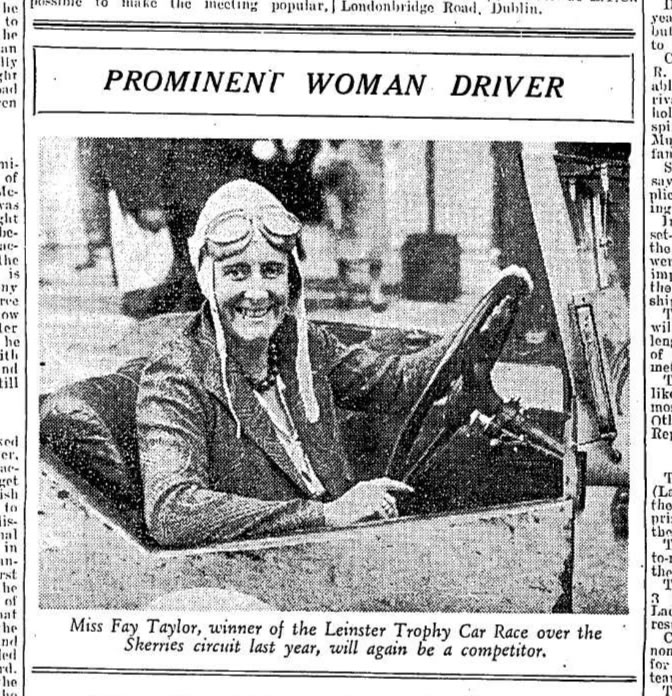
In 1934 Taylour would score what would be her single biggest win in her motorsports career when she won the inaugural Leinster Trophy race held over the Skerries circuit north of Dublin. Taylour recounted her race in her own recollections of the event in her personal correspondence and in her unpublished memoir entitled “I Laughed at Security” referencing her somewhat nomadic lifestyle and personal choices including never marrying or even being engaged throughout her life. Taylour was rarely without male companionship throughout her younger years but was usually attracted to unavailable men.
DRIVING FOR ADLER
Taylour would drive for the “Irischer Adler Rennstall” (Adler Racing Stable) a team set up by Robert Briscoe, a former Lord Mayor of Dublin, member of Dail Eireann and, veteran of the Easter Rising and War of Independence who was the Irish importer and assembler of the upmarket German Adler cars compared to what was available on the market in the early years of the Irish Free State.
Taylour states that she was invited to race for Adler by the Dublin Motor Club (sic.) with Taylour confusing the name of the Leinster Motor Club and she refers to the event as the “Skerries Race” not the Leinster Trophy. By 1934, Skerries was well established as the venue for the Leinster 100/200 motorcycle races and it is probably that Taylour wanted to avoid confusion with either the Phoenix Park Motor Races or the “Round the Houses” race at Bray held the same year. According to Taylour, Briscoe wasn’t so happy when he found out that the driver on offer was a woman. Briscoe, who was of Lithuanian-Jewish heritage and a staunch Zionist, would also have been abhorred to know what was to come in Taylour’s life story, but in 1934 there were little signs of what was to transpire as World War II approached.
As there was a printers strike at the time of the 1934 Leinster Trophy there are very few contemporary reports to orthogonally verify Taylour’s account. But it is highly probable that Nathan Lepler, one of the founders of the Leinster Motor Club and also Jewish, may have negotiated Taylour’s way into the Adler team. Taylour described her race around the 13-mile Skerries circuit for what was to be a 104-mile race run on handicap. Taylour was aware of the challenge: “Races are won on cornering, the more bends the better as far as I was concerned, and I took the trouble to learn each bend by heart, reciting them like a poem while going to sleep the night before the race”.
STRATEGY, SKILL & GOOD FORTUNE
Driving the same car that Paddy Le Fanu had rode to victory in the earlier Bray race that year (albeit with a different engine), Taylour left out in her account that she the circuit layout which was essentially a motorcycle track, had sections that were very narrow and deemed “no passing zones”, where Taylour would deliberately slow down preventing the quicker runners from overtaking her. Either way, Taylour drove a masterful race exhibiting superb skill behind the wheel and excellent race craft. Almost one third of the field failed to finish either through crashes or mechanical issues.
Taylour’s largest stroke of good fortune on the day came when the handicappers saw fit to increase the scratch man Austin Dobson’s handicap by two minutes at the technical inspection when his Alfa Monza turned up with an 8-cylinder engine rather than the expected 6-cylinder. Without that intervention the final result could have been considerably closer. Taylour took home the coveted Leinster Trophy along with a silver-plated brass replica cup that would have an interesting ultimate fate and a check for £50. Recently a photo of Taylour’s 1934 Adler was found that was published in a Dublin newspaper on the eve of the 1935 Leinster Trophy race at Tallaght, a race that Taylour was entered but did not take the start.
GERMANY & POLITICAL ASSOCIATIONS
Already having made several trips to Germany, Taylour now started to spend more time there including visiting the Adler factory and also making contacts with the higher echelons of the German establishment in an attempt to find more cars to drive and more companies to support her racing efforts. She also would go on German radio broadcasts, an activity that she had begun on her travels overseas to Australia and South Africa but would soon come to the attention of MI5 headquarters in London. Taylour would befriend Adolf Hühnlein here, the leader of the German Motor Corps Organisation, the Nationalsozialistisches Kraftfahr-Korps (NSKK) who had influence on the assignment of drivers to Mercedes and Auto Union. Remarkably, over 80 years later, Taylour’s replica Leinster Trophy appeared for sale in a German auction online auction site. The site had little clue about the provenance and importance of the trophy and reportedly it did not sell. It is tempting to speculate that Taylour may have gifted the trophy to Adler or left it there for safekeeping when war broke out.
WORLD WAR II & INTERNMENT
In fact, on her final visit to Germany, Taylour remained in Germany right up one week before war was declared in September of 1939. Taylour’s politics during the run up to World War II took a decided turn to the right. She began associating with several right-wing organisations including Sir Oswald Mosley’s British Union (of Fascists). In this part of the book, Cullen comes into his own as the period immediately covering the beginnings of WWII is his area of knowledge. The roots of Taylour’s leanings most likely began with her mother’s German background, the time she spent in Germany, her association with Adler, and Taylour’s unshakable belief that given both Britain and France were imperialist nations with their own “empires”, Germany’s desire to assert its own manifest destiny was fully justified.
INTERNMENT
The first nine months of World War II were referred to in England as “The Phony War”. There was actually little by way of engagements or direct conflict between Germany and Britain before Dunkirk and the German invasions of Holland, Belgium and France. However, the security and intelligence agencies in the UK were convinced there was a 5th Column that existed in Britain of Nazi sympathisers, spies and other bad actors ready to rise up if a German invasion ever came. Taylour who was actively leafletting and going to underground meetings, soon found herself on MI5’s watchlist and was rounded up with thousands of other suspects in May of 1940. She was interred in Holloway Woman’s Prison under deplorable conditions. Most of those arrested were soon released after signing a pledge guaranteeing loyalty to the crown. Taylour, however, was completely obstinate and refused to sign and she was interred for over three years first in Holloway, then in Port Erin on the Isle of Man.
This prolonged period of detention was to prove very problematic to her in the post-war period when she sought to resume her life in the USA. Eventually she was released and deported to Dublin where the Irish Special Branch would surveil her for years to come. She resumed her contacts with antisemitic and right-wing factions while in Dublin as she moved from relative to relative, few of whom wished to be associated with her in any way. Even when reports of extermination camps and other atrocities began to emerge toward the end of WWII, Taylour never recanted her views nor her admiration for Adolf Hitler. In every other way Taylour appeared urbane, sophisticated and charming but she carried her National Socialist ideology like a badge of honour until she died in 1983.
NEW BEGINNINGS IN AMERICA
As soon as the war ended Fay Taylour wanted to emigrate to the United States. She had become enamoured with midget or sprint car racing on short oval tracks in Australia and the England and wanted to get involved in the American racing scene. After securing an Irish passport she travelled to Los Angeles in May of 1949 where she secured employment at International Motors who imported Jaguar and other luxury and sportscar British marques into the USA. One of her first clients was Hollywood icon Clark Gable who bought the first Jaguar XK-120 in the USA from Taylour. He would go on to own several more during his lifetime. Taylour tried to break into the sprint car racing circuits but would meet the same degree of prejudice, chauvinism and sexism that dogged her efforts in the UK and Australia.
Taylour also tried to get Hollywood interest in her life story for a movie or a book deal. However, whenever it appeared that she was close to getting a deal closed, her wartime interment and political views would come to light. In fact, MI5 continued to monitor Taylour’s movements and associations up to 1976 keeping detailed files on her that they would share with the American intelligence community. This prevented her from ever receiving the type of corporate backing from a major American manufacturer Taylour so desperately needed to launch her motorsports career in the USA.
Despite all these setbacks, Taylour did enjoy some success and now well into her 40’s was still a fierce competitor on the track in sprint races against other women or in races against the clock to set a new lap record. She also appeared on television several times including “The Tonight Show” and “What’s My Line” trading on her pre-war label as the “Speedway Queen” and “Flying Fay Taylour”. She knew how to highlight her femininity always wearing tight fitting dresses and the latest in 1950’s fashion, the bullet bra.
VISA REFUSAL & DECLINE
But another major setback came in 1952 when her father took ill forcing Taylour, who remained close to her father (if not her other family members), to return to England. After her father’s passing, she was informed by the US Consulate in London that her application for a return visa would be dependent on her signing a pledge renouncing her former associations with any right-wing organization affiliated with the German National Socialist movement. As all of Taylour’s associations were just with local English groups, all it would have taken was a little white lie and she would have been clear to re-enter the USA. But Taylour’s obstinance would once again get the better of her and she refused to sign. This led her to be excluded from the Unites States for almost four years, killing her hopes for a racing career there. During this time, she again travelled to race in Australia but she was now entering her 50’s and was still financially insecure. Remarkably, she was still competitive against drivers more than half her age.
Taylour was undoubtedly a naturally gifted driver in any type of machinery and she was also an excellent athlete from her youth spent playing hockey and riding to hounds. In Australia she was still considered a major star and could command decent appearance money at events across the country but not enough to secure financial independence. She would spend much of the next three years traveling back and forth from the UK to Australia but never gave up her efforts to re-enter the USA.
FINAL YEARS – RACING & RETIREMENT
Eventually, while visiting her sister Enid in South Africa, she was granted a US visa in 1955. Taylour joined a coast-to-coast tour of fair grounds when she would be a side-show attraction but the engagement did not appeal to her and contained little of the publicity tours and social rounds that she was used to in England and Australia.
By the end of 1956 she was ready to finally give up racing but Taylour would go on to live for another 27 years. She spent many years trying unsuccessfully to get her memoir “I Laughed at Security” published but book editors and agents refused to work with her due to her un-savory past. Taylour cut somewhat of a sad and forlorn figure during her immediate post-retirement years. After a year spend in Dallas she moved back to Los Angeles where her financial situation, while always perilous, deteriorated to the point where she was penniless, was collecting food stamps and often went hungry. With few transferable skills, finding gainful employment was extremely hard for her but from time to time she would find temporary jobs that also came with accommodations. Twice during this period, much of her personal belongings were lost when in transit from one coast to another, including many of her racing trophies, photos, press clippings and correspondence.
CORRESPONDENCE & BIOGRAPHY
Taylour was a compulsive correspondent and she spent much of her later years writing to friends, fellow drivers and associates she had met with throughout her vagabond existence. Many of these letters survived and formed the basis for a recent biography by Stephen Cullen. By 1965, Taylour had relocated to Norwalk, Connecticut when she got a job as a resident advisor at a woman’s college. She would work there on and off for the next five years while continuing to work on her autobiography. She would vacillate between versions that were semi-fictional accounts of her life as in a movie script to more prosaic accounts of her long and complex journey.
DEATH & LEGACY
Fay Taylour passed away on the 2nd of August 1983 after suffering a series of debilitating strokes. She had spent her final years working on her manuscript and corresponding with her worldwide circle of friends. Her life as a female motorsports pioneer on the global stage has no equal. Despite myriad obstacles of sexism and discrimination she faced, she still competed on the highest levels of motorsport and was competitive in a huge variety of equipment. She was one of the greatest all-rounders of the early 20th century, male of female. However, time and time again, her politics and life choices were her undoing.
++
Coming soon: part two, exploring Fay Taylour’s racing career and her years driving Adler cars.
++
Story by Brian Manning
Brian, a biotechnology professional and motorsports enthusiast, officiated his 40th Formula One event at the 2023 Las Vegas Grand Prix. His interest in motor racing history led him to identify errors in the Leinster Trophy’s record. He received the 2023 RIAC Dudley Reynolds Award for preserving Irish motor racing history. Brian moved from Dublin in 1992, lived in Paris and London and settled in the USA in 1996. He lives in New Jersey with his wife and children.
If you have an idea for a story, please email Kevin Reid at [email protected]
Dennison Trailers generously support the running costs of our website. but rising travel expenses are our biggest challenge. With your support – €2 a month at www.irelandmade.ie we can stay on the road working to preserve and promote Ireland’s transport heritage.
Sources of Information, Photo & Video Credits:
1934 Skerries Leinster Trophy Programme – Leinster Trophy History Facebook page
All photographs – The Fay Taylour Archive
Evening Herald 1891-current, 24.06.1935, page 6
Evening Press – July 16th, 1935
Fay Taylour – ‘The World’s Wonder Girl’ – A Life at Speed – By Stephen M. Cullen. Published by Pen & Sword Books Ltd.
Flying Fay’s fast-paced life. The remarkable Fay Taylour, star of the race tracks – Irish Times – Hugh Oram
Kurt Hutton/Getty Images
RBS Le Fanu driving the same Adler to victory at Bray in 1934. Photo © RIAC Archive
Women Speed Queens (1931) – Pathé Gazette