
Frank Curran – A Lifetime in the Irish Motor Trade | Season 6 – Episode 50 (Part 2)
Wheels Jun 05, 2026
In Part 2 of our interview with Galway man James Francis “Frank” Curran, and in our 550th episode, we continue exploring a career that began in the Irish motor trade in 1955, when Frank started his apprenticeship at Abbey Service Garage in Galway at just fifteen years of age.
Frank recalled the distinctive Allgaier Porsche-designed tractors and some of the problems they faced in Irish farming conditions. During meitheal time, the tractors lacked the pulley needed to power threshing machines, while their original exhaust design caused fumes and posed a fire risk in dry hay fields. Farmers also struggled with the tractors’ unusual fluid flywheel system, often leading to burned-out clutches.
Through Frank’s vivid memories, Part 2 offers another fascinating insight into Ireland’s changing motor and agricultural engineering industries during the 1950s.
**
While Dennison Trailers kindly sponsors the Ireland Made website, all filming and production costs including travel, equipment, editing software, Meta verification, music licensing and long-term data storage are completely self-funded by Kevin Reid.
If you enjoy my weekly stories, please subscribe as your support will help me to continue preserving Ireland’s transport heritage.
**
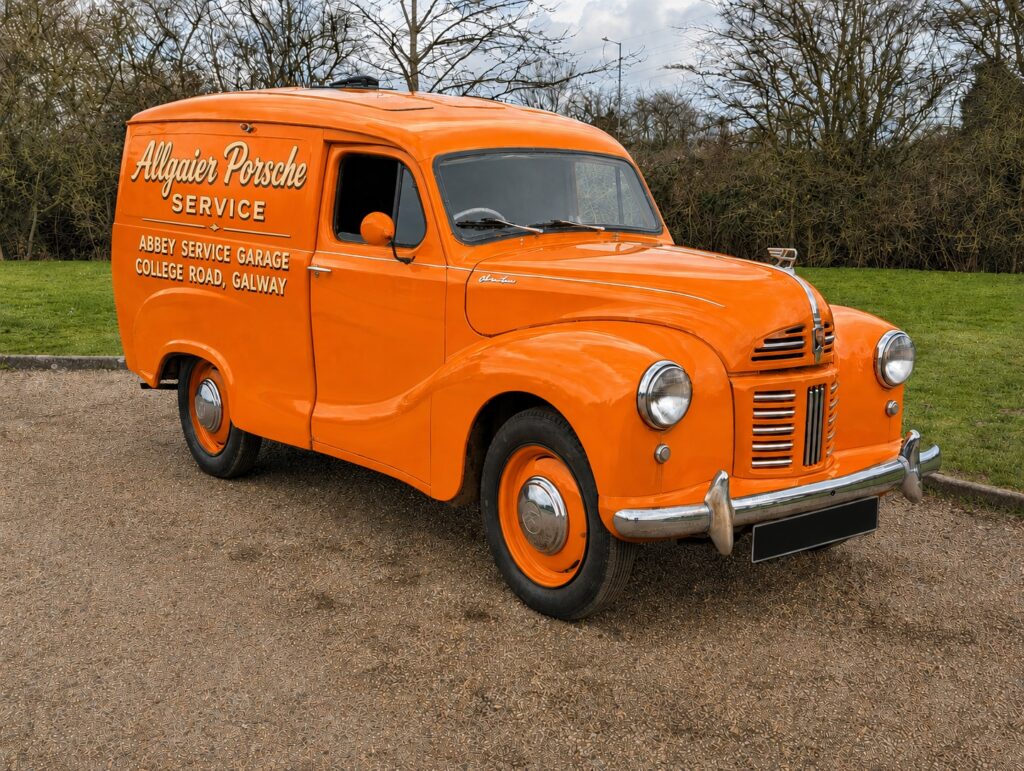
THE NEW SERVICE VAN
While working in Abbey Service Garage, Frank was a pretty good spray painter. The garage had a grey Austin A40 Devon van and Dennis Clarke got the idea that they would respray the van in Allgaier Porsche orange. The Allgaier Porsche tractors built in Ireland at Borris in Ossory were all painted orange, so according to Frank, if you see a green or red Allgaier Porsche, it is not an Irish one.
They resprayed the Austin A40 van in bright Allgaier Porsche orange and had a signwriter paint Allgaier Porsche Service, Abbey Service Garage, College Road, Galway on the side. It became the service van and carried the tools, spare parts and the stands used to support the tractor at both ends when it had to be split in two to fit a clutch.
As it went, Frank usually did the work on the tractor while Johnny serviced the farmer’s car and made a few bob for himself on the side!
The Allgaier Porsches ran on rubber wheels, as rubber had become available after the war. These tyres changed the face of agricultural machinery because you had all sorts of tractors such as the Lanz, Steyr and Field Marshall. The Steyr later became part of Steyr Daimler Puch.
As Frank recalls, “In later years, when I worked in Lucan, County Dublin, we had two of them that used to come into the garage for service, a big single cylinder thumper of a Steyr tractor.” We will bring you more about Frank’s time in Lucan, County Dublin, in a later episode.
MOVING TO DUBLIN
Frank was working in Abbey Service Garage in Galway when the Vauxhall Victor FA was launched in 1957, “which had the exhaust pipe emitting through the bumper at the back”. He was speaking to Tommy Walsh, the mechanic to whom the cars were mostly assigned, who said to him, “Good God Curran, imagine if a fella had one of them now and £1,000 a year.” Back then, £1,000 a year was the Holy Grail and would have worked out at about £20 per week.
Because of the poor wages he was receiving in Galway, Frank decided to move to Dublin. The move did not come about entirely of his own volition. It happened after a friend of his in Galway wanted to buy a van and G.A. Brittain Radio Hire, headquartered in Rathmines were selling off a number of Morris Minor vans from their assembly plant in Ringsend. Frank travelled to Dublin with his friend and bought a Morris Minor van.
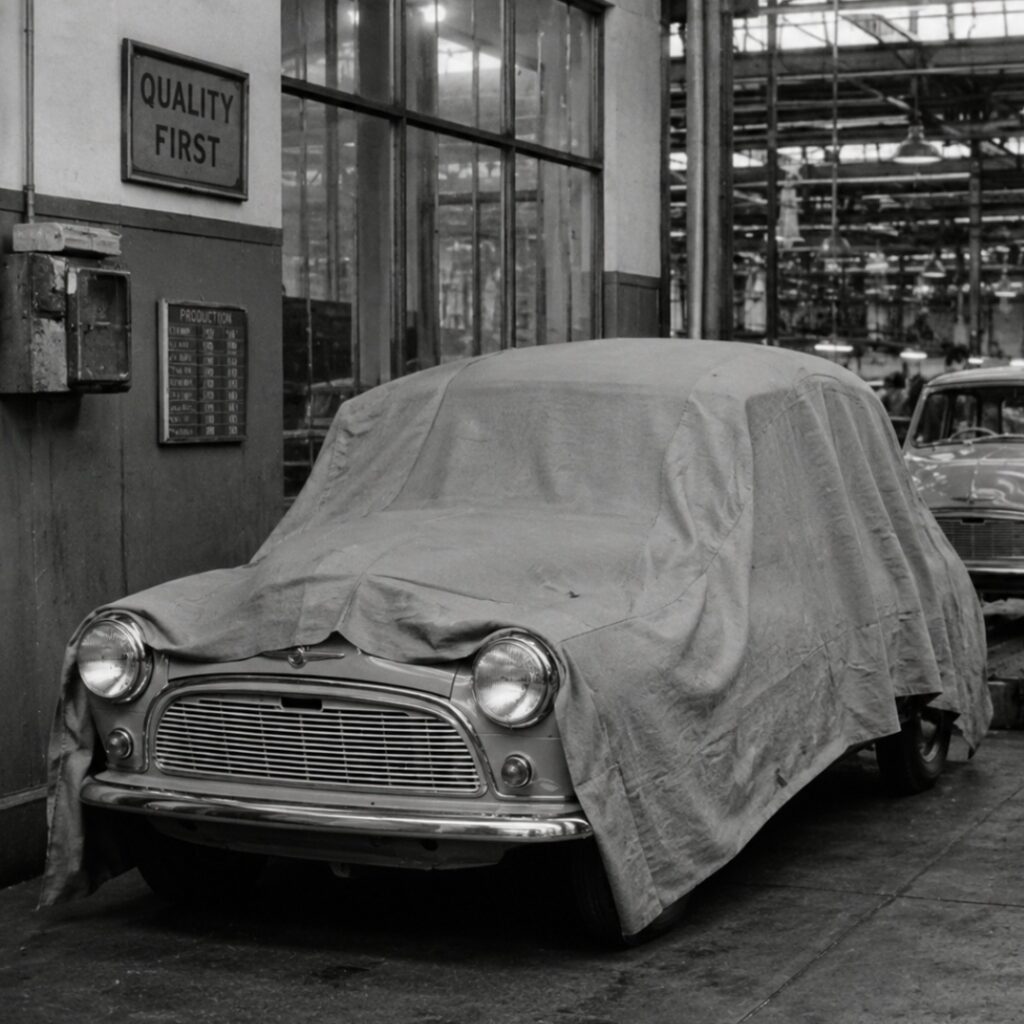
MINI PROTOTYPE
While his friend Martin Divilly was in the office paying for the van, Frank noticed a car in the corner of the assembly plant covered with a cloth. He went over and lifted the cover to find a prototype Mini underneath. Frank is proud to be able to say that he saw the Mini before it became available on the market.
The Mini was on trial in Ireland and was being tested. Within the company it was known as ADO15, short for Austin Drawing Office Project Number 15.
NEW VW BEETLE ROOF
Frank and Martin then went to get a couple of tyres for the van and ended up at the Castle Hotel on Great Denmark Street. The hotel was across the road from Rutland Place, where there were loads of little garages. One of them was run by a chap called John Scahill, who also sold tyres, and they got two tyres fitted to the van there.
While there, Frank met a chap called Stan Ryan, who told him he had just bought a Volkswagen Beetle which had been rolled and needed a new roof. Frank told Stan that he would be getting his summer holidays the following week and said, “If you get the roof, I will put it on for you.”
The following week, in September 1958, Frank moved to Dublin. He fitted the new roof to the Volkswagen Beetle and began the next chapter of his working life in the capital.
Our thanks to Frank Curran and to Sean O’Sullivan
Check out Part 1 of our interview with Frank Curran:
If you have an idea for a story, please email Kevin Reid [email protected]
Sources of Information, Photo, Video & Music Credits:
All music and sound effects used in Ireland Made – Stories of Irish Transport are royalty free and are fully licensed through Epidemic Sound. Ireland Made – Stories of Irish Transport therefore holds the legal right to use this audio material within its productions under the terms of the Epidemic Sound licensing agreement.
Anglia Auctions
Aron Line – Ian Nicholls
Complete Car
Flickr
Get Your Classic
Handh Auction House
Old photos of Carlise and surrounding area – Pam Blaine
Photograph – David Boden
Successful Farming
Tamar Vintage Tractors
The Illustrated Encyclopaedia of Tractors
The Irish Independent
Vintage Tractors website
Wiki Creative Commons