
While Britain ruled the waves from the Battle of Trafalgar in 1805 to the outbreak of the First World War in 1914, its maritime law lagged behind. This was evident in 1912, when the Belfast built SS Titanic was lost and safety regulations were outdated and deficient. In this story, we examine the disaster from an alternative angle, focusing on the lifeboats, just 20 in total, with capacity for 1,178 people, little more than half of the 2,209 on board, and the role of J Bruce Ismay, Chairman of the White Star Line, who later went into exile in County Galway and the enduring question of whether he was a lifeboat hero or villain in the aftermath of the disaster.
WHITE STAR LINE SHIPS
Titanic and her sister ships, Olympic and Britannic, were built to rival Cunard’s Lusitania and Mauretania, as the White Star Line focused on constructing larger and more luxurious vessels.
Construction of the S.S. (Steam Ship) Titanic commenced on March 31st 1909 at yard number 401 in the Harland and Wolff shipyard in Belfast, County Antrim. The vessel was built on slipway number three beneath a gantry rising 69 metres, the largest of its kind in the world at the time. The build employed around 14,000 men, rising to 15,000 at peak. Shipbuilding in the early 1900s was a dangerous business and the Titanic Facts website reports; “There was an unwritten expectation in shipyards at the time of ‘one death for every £100,000 spent’, so at a build cost of £1.5, the Titanic’s toll was less than the 15 deaths that might have been expected.” The Titanic was launched into the Victoria Channel in Belfast Lough on May 31st 1911.
Bruce Ismay later stated at the U.S. inquiry into the Titanic’s sinking that its construction cost adjusted for modern inflation and exchange rates was approximately €153,000,000. Notably, this is less than the budget of the 1997 film “Titanic” which cost €172,300,000.
SINKING OF THE TITANIC
On her maiden voyage, Titanic departed Southampton on April 10th 1912, calling at Cherbourg in France and Queenstown, now Cobh, in Ireland, before setting out across the Atlantic for New York. In the late evening of April 14th 1912, the 882 foot long Titanic struck an iceberg in the North Atlantic. The impact along the starboard side opened several of the ship’s 16 watertight compartments to the sea. Although designed to remain afloat with up to four compartments flooded, the damage extended beyond this design limit. The liner gradually filled as water spilled from one compartment to the next. In the early hours of April 15th, she broke apart and sank, with the loss of more than 1,500 lives.
THE LIFEBOATS
When Titanic was built, British maritime law, governed by Board of Trade regulations based on an 1894 Act, had not kept pace with the scale of modern ships. The rules required only 16 lifeboats for vessels over 10,000 tons. Titanic, at 882 feet 9 inches in length and with a displacement of 52,310 tonnes when fully loaded with passengers, cargo and coal, far exceeded those thresholds.
It is widely claimed that, at the design stage, J. Bruce Ismay, Chairman of the White Star Line, ordered the reduction in lifeboats from 48 to 20 to meet Board of Trade minimum requirements and allow for more open deck space. Although the S. S. Titanic complied with the regulations, she carried lifeboat capacity for only around 53% of those on board.
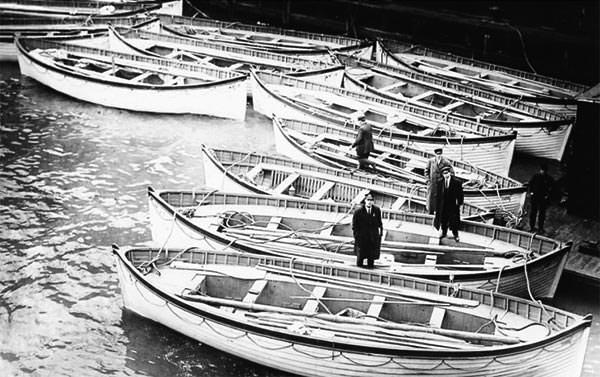
Titanic carried 20 lifeboats of three types: 14 standard wooden lifeboats, two emergency wooden cutters and four collapsible canvas boats. The 14 standard boats, each with a capacity of 65 persons, were constructed by Harland & Wolff at Queen’s Island, Belfast. The two emergency cutters each carried 40 persons, while the four Engelhardt collapsible boats, built by McAlister & Son of Dumbarton, had a capacity of 47 persons each and were labelled A to D. Lifeboats 1 to 16 were numbered, with odd numbers on the starboard side and even on the port. All lifeboats were launched using Welin quadrant davits, supplied by the Welin Davit & Engineering Company, which were capable of handling more boats than were actually carried.
The lifeboats and cutters were robustly constructed, with keels of elm and stems and stern posts of oak and were double-ended for improved seaworthiness. They were clinker built in yellow pine, double fastened with copper nails and fitted with pitch pine seating. Each lifeboat incorporated buoyancy tanks made from 18 ounce copper, in line with Board of Trade requirements.
All boats were fully equipped to the same standards. Sails were supplied for each lifeboat and cutter and stowed in painted bags and a sea anchor was issued to every boat, along with a compass housed in a dedicated locker. Each carried a provision tank and a water beaker for use at sea. The lifeboats were also marked with a brass plaque bearing the name S.S. Titanic in relief, accompanied by a plate in the form of the White Star Line emblem.
Following the rescue of Titanic passengers by the SS Carpathia, all 14 standard 30 foot lifeboats were towed back to New York Harbour.
LIFEBOAT DEBACLE
The evacuation of the sinking Titanic exposed a clear failure of capacity and procedure. Although the lifeboats could accommodate only around half of those on board, many were launched well below capacity, with Lifeboat No. 1 lowered carrying just 12 people. The first boat, No. 7, was launched at 12:40 am, while the last, Collapsible D, left the ship at 2:05 am. Crew concerns that the boats might buckle if fully loaded, combined with limited training and slow organisation, resulted in boats being dispatched partially filled, amid confusion and a widespread disbelief by the passengers that the ‘unsinkable’ Titanic would actually sink.
INQUIRIES HELD
Both British and American inquiries were conducted into the disaster. While their findings differed slightly, with U.S. reports recording 1,517 deaths and British reports 1,490, it is generally accepted that of the more than 2,200 passengers and crew on board, around 700 survived and over 1,500 lost their lives.
The British inquiry acknowledged the shortage of lifeboats but found that Captain Smith was not negligent, noting the ship was operated in ice infested waters in line with standard practice and Bruce Ismay was ultimately cleared of personal wrongdoing by both inquiries.
ISMAY’S FATE
It was standard for Ismay to accompany his ships on their maiden voyages, which is why he was on board Titanic. As Chairman of the White Star Line, he was among the first to be informed by Captain Smith of the iceberg damage on the evening of the collision and would have immediately understood the peril.
He is reported to have helped prepare lifeboats and assist women and children into them, later stating at the American inquiry, “I assisted, as best I could, getting the boats out and putting the women and children into the boats.” As it became clear the ship would sink before help arrived, Ismay, reportedly after ensuring no passengers remained nearby, boarded Engelhardt ‘C’, the last boat lowered by davits and escaped. Around 20 minutes later, Titanic slipped beneath the waves.
On his arrival in New York, Ismay faced intense criticism from the press on both sides of the Atlantic. He was accused of reducing the number of lifeboats at the design stage to allow for more open deck space and of urging Captain Smith to maintain speed in ice-infested waters.
Public anger was sharpened by the fact that he survived while so many women and children, particularly from the working class, had perished. Ismay became a natural target for blame and was widely branded the “Coward of the Titanic”. In the early 1900s, public expectation held that a leader should go down with his ship, as Captain Edward Smith did, and Ismay’s decision to board a lifeboat was seen as a breach of that code.
Newspaper magnate William Randolph Hearst, who held a personal grudge against Ismay, used his media empire to amplify the story of his escape. Headlines branded him “J. Brute Ismay” and carried false claims that he had disguised himself as a woman to secure a place in a lifeboat.
Historians and researchers often contend that Ismay’s vilification was largely unjustified. Evidence suggests he spent considerable time assisting passengers into lifeboats and only entered one of the final boats when no women or children remained nearby.
CONNEMARA
Ismay was largely shunned by London society and this along with public hostility led to his resignation as Chairman of the White Star Line in 1913, after which he withdrew from public life and took up residence at Costelloe Lodge in Connemara, County Galway.
In Connemara, Ismay was locally given the nickname “íochtair dom síos” (Irish for “lower me down”), a pointed reference to his ‘lucky’ escape in a lifeboat. Yet, despite this, he was generally remembered as a quiet and considerate employer, who devoted his later years to fishing and to supporting the local community through small acts of philanthropy.
Costelloe Lodge was burned down by the IRA in 1922 and later rebuilt. Ismay remained a resident of Connemara for 25 years before moving back to England after being diagnosed with diabetes.
Near the end of his life, Ismay is believed to have said, “I never want to see a ship again and I loved them so. What an ending to my life.” J. Bruce Ismay (1862–1937) died in London on October 17th 1937, aged 74 and is buried there.
TITANIC LEGACY
Today, 113 years later the wreck of Titanic lies 2.3 miles deep on the floor of the North Atlantic. It is recognised as a maritime grave for approximately 1,500 victims and is protected under international law.
The Titanic disaster prompted major reform of maritime law, leading to the 1914 SOLAS (Safety of Life at Sea) convention, which introduced modern standards for lifeboats, wireless operation and passenger drills. Today, regulations require lifeboat capacity for at least 75% of those on board, with the remainder in life rafts, though many ships exceed this by providing full capacity through fully enclosed survival boats.
If you have an idea for a story, please email Kevin Reid [email protected]
Sources of Information, Photo, Video & Music Credits:
All music and sound effects used in Ireland Made – Stories of Irish Transport are royalty free and are fully licensed through Epidemic Sound. Ireland Made – Stories of Irish Transport therefore holds the legal right to use this audio material within its productions under the terms of the Epidemic Sound licensing agreement.
Encyclopaedia Titanica – Description of the design and construction of Titanic’s lifeboats
Getty Images
Historic History UK – Bruce Ismay – Hero or Villain by James Pitt
Irish Central Website
Titanic Facts website
WIKI